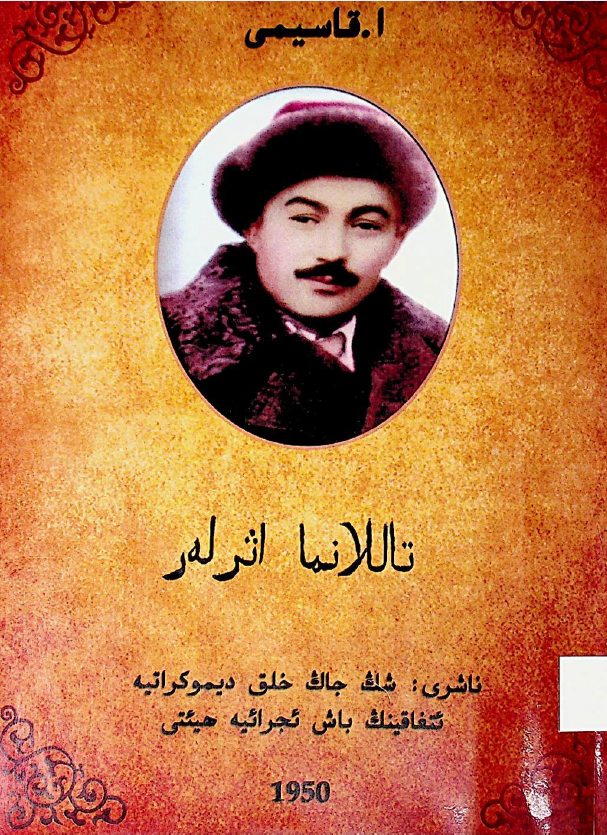

This collection, titled “Selected Works of Ahmetjan Qasimi”, was published in 1950 by the Executive Committee of the Xinjiang People’s Democratic Association to commemorate the first anniversary of the late Ahmetjan Qasimi, the leader of the Ili Revolution. The compilation includes significant articles, works, and speeches written or delivered by Ahmetjan Qasimi between 1945 and 1949. The language and orthography of the included works were edited based on the old Uyghur orthography used during the 1940s.
In the foreword written by the editorial team, it is emphasized that the original plan was to publish a multi-volume collection of all of Ahmetjan Qasimi’s works and articles about him on the occasion of the first anniversary of his passing. However, due to various reasons, this plan could not be realized. It is noteworthy that this collection remains the only book published about Ahmetjan Qasimi’s works since his death.
The collection includes articles and speeches that address topics such as the causes of the Ili Revolution, the establishment process of the East Turkestan Republic, the tasks and goals of the national revolution, the role of intellectuals in the national liberation movement, the mistakes and shortcomings encountered during the national revolution, and the role of national education in awakening colonized nations. Furthermore, the collection explores subjects such as the reasons behind the East Turkestan Republic’s negotiations with the Kuomintang government, the formation of the “Provincial Coalition Government,” the importance of unity and solidarity in the national revolution, the damages caused by nationalism and nationalists to the national revolution, the impact of the global situation following World War II on the direction of the East Turkestan Revolution, and the geopolitical situation of East Turkestan, which necessitated friendly relations with the Soviet Union.
A particularly noteworthy article included in the collection, titled “On East Turkestan Again”, presents Ahmetjan Qasimi’s perspective as a leader of the national revolution. In this article, he argues that the term “East Turkestan” is the most accurate and acceptable geographical name for the Uyghurs’ homeland, while the Chinese name “Xinjiang” clearly conveys colonial implications. He explains that this is why the Uyghur people reject the name “Xinjiang”.
Overall, the 19 articles and speeches included in this collection reflect Ahmetjan Qasimi’s stance, ideology, and political goals regarding the East Turkestan Revolution of the 1940s. This collection is not only essential for studying Ahmetjan Qasimi’s ideas on the national revolution but also serves as a primary source for understanding the history of the Ili Revolution and the East Turkestan Republic of the 1940s. Importantly, it provides an account of the East Turkestan Revolution based on the testimonies of key historical figures who witnessed these events, rather than through the lens of the Chinese government’s historical narrative or propaganda framework.
Additional Information
Author (Creator): Ahmetjan Qasimi
Language: Uyghur
Release: The Executive Committee of the Xinjiang People’s Democratic Association
Date of Release: Ürümqi, 1950
Pages: 324
Era: Guomindang era (1912-1949); East Turkestan Republic period (1944-1949)
Ahmetjan Qasimi
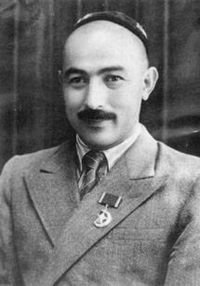
Ahmetjan Qasimi (1914–1949) was a prominent figure, politician, and revolutionary in 20th-century Uyghur history. He played a critical role in the Ili Revolution of the 1940s and in the establishment of the Second East Turkestan Republic (ETR). Ahmetjan Qasimi held key positions in the ETR and was widely recognized by the Uyghur people as a “national revolutionary leader.”
Ahmetjan Qasimi was born in 1914 in Ghulja. During his childhood, his family relocated to the Soviet Union, where he attended primary and secondary schools. Later, he was admitted to the State University of Central Asia in (SAGU) Tashkent. In 1936, he enrolled at the Communist University of the Toilers of the East in Moscow and became a member of the Communist Party of the Soviet Union. In 1939, he was conscripted into the Soviet Red Army and fought in the Winter War against Finland, during which he was severely injured. After recovering in the Soviet Union’s Central Asian republics, he returned to his hometown, Ghulja in East Turkestan, in 1942 after restoring his Chinese citizenship.
When the Ili Revolution broke out in 1944, Ahmetjan Qasimi joined the national revolution, earning recognition for his leadership, profound knowledge, and exceptional abilities. He was appointed head of the military department in the East Turkestan Republic government. In October 1945, during peace negotiations in Ürümqi between the ETR and the Kuomintang government, facilitated by the Soviet Union, Ahmetjan Qasimi was chosen as one of three ETR representatives. After eight months of negotiations, the “Eleven-Point Agreement” was signed in June 1946, which established the “Xinjiang Provincial Coalition Government.” Ahmetjan Qasimi was appointed vice-chairman of the coalition government and moved to Ürümqi.
In the summer of 1947, the coalition government collapsed, prompting Ahmetjan Qasimi to return to Ghulja with the Ili representatives. He resumed leadership of the East Turkestan Republic’s affairs. During this period, tensions persisted between the ETR’s national army and the Kuomintang forces along the Manas River. In August 1948, Ahmetjan Qasimi founded a political and mass organization called “Unity” in Ghulja, which oversaw the administration of the ETR.
By 1949, the Chinese Communist Party (CCP) had consolidated power across China. In August of that year, Mao Zedong, the chairman of the CCP, sent a telegram inviting the leaders of the ETR to attend the upcoming Chinese People’s Political Consultative Conference in Beijing. On August 22, 1949, the Soviet Union summoned Ahmetjan Qasimi and other key leaders of the ETR to Almaty for urgent discussions regarding the future of the East Turkestan. The Soviet Union demanded that they accept CCP leadership. Ahmetjan Qasimi agreed, on the condition that East Turkestan would join the newly established People’s Republic of China as an “union republic” status.
On August 24, 1949, Ahmetjan Qasimi and other ETR representatives boarded a Soviet plane bound for Beijing. However, the plane mysteriously crashed near Lake Baikal, killing all 11 passengers on board. The deaths of Ahmetjan Qasimi and the other ETR leaders were kept secret from the Uyghur people for three months. In December 1949, after the Chinese People’s Liberation Army entered East Turkestan, the dissolution of the ETR was officially announced, and the deaths of its leaders were publicly confirmed.
In April 1950, the remains of Ahmetjan Qasimi and other ETR leaders were transported to Ghulja for burial. Mao Zedong posthumously honored them as “revolutionary martyrs” and described the Ili Revolution as “part of the Chinese people’s democratic revolution.” However, many Uyghurs have long believed that Ahmetjan Qasimi and the ETR leaders were victims of a political conspiracy jointly orchestrated by the Soviet Union and Communist China in 1949. After the collapse of the Soviet Union in 1991, some surviving witnesses from Central Asia published memoirs and accounts, asserting that the plane crash was, in fact, a deliberate political assassination [Asim Baki, “The Mysterious Assassination: The Bloodshed,” Tashkent, 1992].
Although the CCP recognized Ahmetjan Qasimi and the ETR leaders as “revolutionary martyrs” in the 1950s, in recent years—particularly since 2016, during the ongoing “ethnic genocide” against Uyghurs—books, historical photos, archival materials, and documentaries about them have been heavily restricted. Texts and images of Ahmetjan Qasimi have been removed from Uyghur language textbooks in primary and secondary schools.
Ahmetjan Qasimi’s speeches and writings from 1945 to 1949 were compiled and published in Ürümqi in 1950. Since then, however, the Chinese government has not permitted any reprints of his works.
